
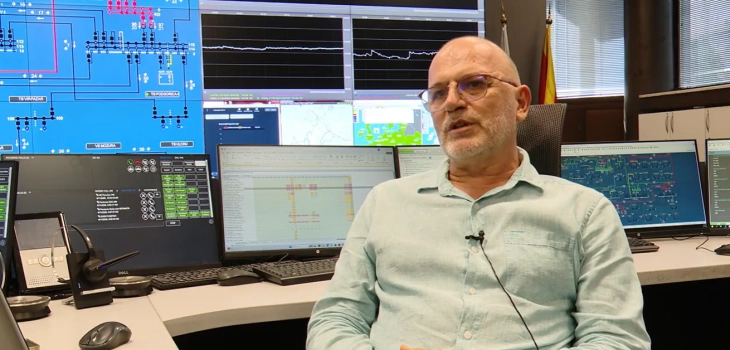
Podgorica (MINA-BUSINESS) – Montenegro’s power system is stable, and no disruptions in electricity supply to consumers are expected, said Ranko Redžić, Director of the National Dispatch Centre of Crnogorski elektroprenosni sistem (CGES). He added that transmission system losses are at a level comparable to the best-performing European systems.
“The power system is stable, and we do not expect any problems with electricity supply to consumers in Montenegro as far as the transmission system is concerned. All system elements are in operation, while consumption remains within the expected range for this time of year,” Redžić said in an interview with the Mina-business news agency.
He explained that system security can be viewed from two perspectives: the security of operation within the interconnected power system and the security of electricity supply to consumers in Montenegro.
“This has been a particular focus in recent years, primarily due to connecting the growing number of renewable energy sources and, in particular, the development of the electricity market. Market conditions mean that electricity is constantly flowing from lower-price zones towards higher-price zones, resulting in a significant increase in transit flows and fluctuations depending on the time of day,” Redžić explained.
According to him, the so-called solar hours are currently the most critical period, particularly when large volumes of electricity are exported from Southeast Europe towards the west, or potentially in the opposite direction if prices in Western Europe are more favorable than those in the east.
“Prices in individual markets are determined on an hourly basis according to supply and demand, and fluctuations in prices throughout the day are reflected in the physical flows of electricity,” he noted.
The new 400 kV Pljevlja–Lastva transmission line entering trial operation has, in his assessment, significantly improved the operational security of the power grid in Montenegro and the wider region, substantially reducing the possibility of disturbances with regional implications.
Speaking about the security of electricity supply to consumers in Montenegro, Redžić said that the summer season is traditionally the most critical period, particularly along the coast, where consumption and the loading of critical network elements increase significantly, at times approaching their technical limits.
“It is worth recalling that last year there were no interruptions in electricity supply along the coast caused by disturbances in the transmission system. For this season, CGES has taken additional measures by implementing a project to install high-temperature conductors on the Lastva–Budva and Lastva–Tivat transmission lines. This has significantly improved the security of supply to Budva and the part of the coast west of Budva,” Redžić explained.
Asked about the level of electricity losses in Montenegro’s transmission system and the measures CGES is taking to reduce them, Redžić said that losses in the transmission system are exclusively technical in nature and are a consequence of the physical laws governing the flow of electric current through conductors.
“Some information recently published in the public domain has not provided a sufficiently clear picture of transmission and distribution loss rates. I would therefore like to emphasize that, last year, the physical volume of losses in the transmission system amounted to 131 gigawatt-hours (GWh), corresponding to a loss rate of 1.64%,” Redžić stated.
He recalled that in 2024, the physical volume of losses was somewhat higher, at 143 GWh, but the loss rate stood at 1.55%.
“The loss rate is the percentage of losses relative to the total amount of electricity transmitted. For comparison with European practice, Austria provides a relevant example, with the loss rate loss rates of 1.63% and 1.52% over the previous two years, respectively,” Redžić said.
He explained that comparisons with European transmission system operators do not provide a completely accurate picture, as CGES’s figures include the 110 kV network, which accounts for the highest losses, whereas the Austrian transmission system operator (APG), as is also the practice throughout Western Europe, reports data only for the 400 kV and 220 kV networks.
“It may sound immodest, but it turns out that CGES has a better result in this regard than APG,” Redžić added.
When compared with the systems in the region, where, as in Montenegro, the 110 kV transmission network is included in the calculation, CGES records significantly lower losses.
“For example, data for the Croatian Transmission System Operator (HOPS) show that its loss rate in 2024 stood at 1.86%. By comparison, Montenegro’s loss rate that year was 1.55%. For the Independent System Operator in Bosnia and Herzegovina (NOSBiH), the loss rate stood at 1.79% in 2024 and 1.88% last year,” Redžić said.
He noted that losses in Montenegro’s electricity transmission system are at a level comparable with those of the best-performing European systems, and said that CGES would strive to maintain this standard in the future.
Asked about the most significant investments in Montenegro’s electricity system that have been completed to date, as well as those planned for the coming period, Redžić said that several major capital projects had been completed this year.
“The most significant is the Lastva–Pljevlja transmission line, which is 150 kilometers long and entered trial operation at the end of June. Montenegro now has a 400 kV transmission ring, which significantly improves the operational security of the Montenegrin power system, as well as that of other systems, and further increases the capacity for connecting renewable energy sources,” Redžić said.
At the same time, the 110 kV Žabljak–Pljevlja transmission line was also put into operation, improving the security of electricity supply to consumers in the Žabljak and Pljevlja areas and enabling the safer integration of electricity generated from renewable energy sources connected in the vicinity of the Brezna substation (SS).
“We are also installing a 250 MVAr shunt reactor at the Lastva substation, which addresses the major problem of excessively high voltages in Montenegro’s power system and the surrounding region. By doing so, CGES is also making a significant contribution to mitigating this problem. The reactor entered trial operation at the beginning of April, but is currently out of service due to the rectification of identified deficiencies and additional testing. We expect it to be put back into operation by the end of September,” Redžić said.
He noted that another investment involved the installation of a new 150 MVA transformer at the Podgorica 1 substation. The older transformer was replaced, thereby improving the reliability of electricity supply to consumers, particularly in the Podgorica area.
“There are several highly significant projects planned for the coming period. These include, first and foremost, the construction of the 400 kV Brezna substation, which will enable a significantly greater number of renewable energy sources to be connected in the region, as well as the reconstruction of the 220 kV transmission line along the Herzegovina–Montenegro–Albania corridor,” Redžić announced.
He said that other significant projects include the reconstruction of the switchyard at the Perućica hydropower plant, the completion of the installation of two 400 MVA transformers at the Pljevlja substation, and the completion of the 400 kV interconnection with Serbia.
“This will mark the completion of the so-called Trans-Balkan Corridor on the territory of Montenegro, thereby enabling the connection of a second submarine cable to Italy,” Redžić explained.
He also announced the construction of a number of new substations and shorter transmission lines, which will enable additional consumers to be connected to the distribution network, as well as additional renewable energy sources. He added that the total value of planned investments over the next five years exceeds EUR 200 million.
Asked about the activities CGES is undertaking to couple Montenegro’s electricity market with the single European electricity market and the expected effects of this process, Redžić said that, over the past period, CGES had provided significant support to the Ministry of Energy in preparing a package of energy-sector legislation fully aligned with the EU acquis.
“The laws have been adopted by Parliament, and we are currently awaiting the European Commission’s (EC) compliance assessment report,” Redžić added.
He believes that the further pace of market coupling will depend on the outcome of the compliance assessments, as the next formal steps in this process can only be taken once a positive report has been received.
“In any case, market coupling between Montenegro and Italy, and consequently Montenegro’s integration into the EU single electricity market, is expected in 2028, or by 2029 at the latest, depending on the timing of these reports,” Redžić said.
He concluded that the adoption of the package of legislation known as the Electricity Integration Package in Montenegro significantly contributes to improving system security, as system operation and cooperation among transmission system operators in the region would be aligned with the best European practices, thereby further improving system performance and the security of electricity supply to consumers.”