
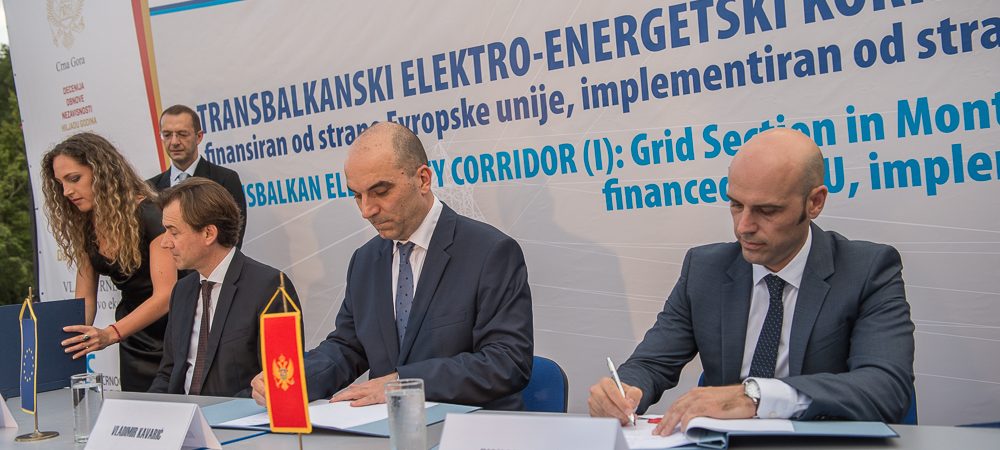
 "Good transport connectivity is key for the marketing of all goods and services that are produced or will be produced in Montenegro, while good energy connectivity is necessary both for future investments in the energy sector and for the free flow of energy through Montenegro, from which Montenegro has clear financial and strategic benefits" said today in Lastva Grbaljska the Minister of Economy, Dr Vladimir Kavarić, at a ceremony marking the signing of the Financial Agreement for the construction of the Trans-Balkans Electricity Corridor – Montenegro section, which is financed by the European Union and implemented by the German Development Bank (KfW). Minister Kavarić recalled that the Berlin Process has enabled our countries to resolve long-standing problems in the flow of goods and services, through the possibility of financing transport and energy connections with the region and further with the European Union. "The Trans-Balkan Corridor, which will connect Montenegro with Serbia, is a project that was approved at last year's summit in Vienna. The project involves strengthening Montenegro's submarine cable-connected infrastructure and the construction of a transmission line between Montenegro and Serbia. The total value of the project is 127 million euros. The Montenegrin electricity transmission system, with the help of the Government of Montenegro, has secured loan financing from the EBRD and KfW, and the contract we are signing today represents the co-financing of that loan financing with a grant of 25 million euros," emphasised Minister Kavarić. The Minister of Economy recalled that the project, for which the donation financing agreement was signed today, is of gigantic importance for the energy sector and the overall economy of Montenegro. "The interconnection with Italy via a submarine cable is in itself a priority for this country. It places Montenegro at the centre of the energy flows in this part of the world and completely changes the outlook for all other neighbouring countries, giving them the opportunity to connect to Western Europe via Montenegro. But the cable with Italy will only have its full force and purpose with the realisation of this project," Kavarić concluded. The Head of the Cooperation Section of the EU Delegation to Montenegro, Andrey Lis, stressed that improving connectivity within the Western Balkans, as well as this region's connection to the European Union, is an important foundation for economic development and for building bridges between people and businesses. He stated that for this reason, the EU has placed connectivity high on the list of priorities in the enlargement process and has allocated one billion euros for technical assistance and investment in projects from the connectivity agenda by 2020. "Today we are witnessing the signing of a financial agreement for the construction of one part of the Trans-Balkan electricity corridor. This is a sign of our concrete support for Montenegro and the region. This project will contribute to the establishment of a regional electricity market, which will be connected to the European Union via a submarine cable between Italy and Montenegro. This will further contribute to the better integration of Montenegro's electricity transmission system with the European energy market," Lis recalled, emphasising that the issue of connectivity is not exclusively linked to expensive infrastructure projects. "It is equally important for the countries of the Western Balkans to step up their efforts in implementing reform measures to open up their markets and create a transparent regulatory framework that builds investor confidence, as well as for the countries of the region to develop the mutual trust necessary for reconciliation, good neighbourly relations and prosperity. That is the key to your path towards membership of the European Union," concluded Lis. Roland Siler, a member of the board of the German Development Bank for Europe and Asia, said that the Trans-Balkan electricity corridor will not only improve and stabilise the electricity supply in the regions concerned, but will also enable the integration of markets, the creation of new business opportunities and the generation of revenue for Montenegro. "Last but not least, the Corridor will represent an important milestone in Montenegro's integration into the European energy market," said Siler, emphasising that KfW will remain a reliable financial partner for future projects. He added that other projects in the transmission sector are already in preparation. "Of course, other concrete projects in the fields of hydroenergy, energy efficiency and distribution are also in preparation," Siler announced, stressing that it goes without saying "that we are on your side as the leading financial institution for the second EU infrastructure project you wish to be co-financed by the Western Balkans Investment Framework".
  CGES Executive Director Ivan Bulatović said that the Donation Agreement for the implementation of the Trans-Balkans Power Transmission Corridor – Montenegro section, in addition to its global political and economic significance, also holds special importance for the company. "We are proud to be able to realise our plans, outlined in national and regional development documents, through an institutional framework that has, from the very beginning, given an additional impetus to the development of our society and the even faster adoption of European standards and norms," Bulatović emphasised. He added that the infrastructure project to connect the electricity systems of Montenegro and Italy, as the most significant project of CGES, has received further confirmation of its importance with this grant, both in European and regional contexts. "First and foremost, through the fact that these funds will finance the construction of the 'Pljevlja – Bajina Bašta', which is directly linked to the aforementioned project, as well as the accompanying investments in Montenegro's electricity transmission network connected to the aforementioned interconnections with Italy and Serbia. The importance of all these investments for the stable and reliable operation of the electricity transmission system need hardly be emphasised," concluded Bulatović. The contract, worth 25 million euros, was signed by Minister Kavarić on behalf of the Ministry of Economy, Mr Siler on behalf of the German Development Bank, and the Executive Director of CGES, Mr Bulatović.