
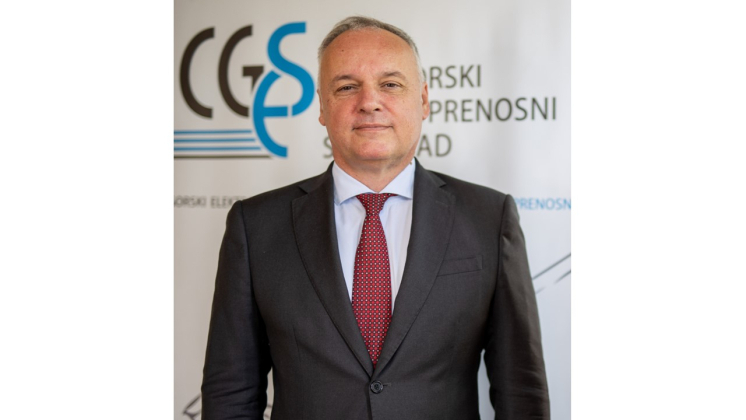
Interview of the Chairman of the Board of Directors, Aleksandar Mijušković, with MINA Business by the agency
Podgorica, (MINA- BUSINESS) – The Montenegrin Electricity Transmission System (CGES) achieved a record profit of EUR 35.7 million last year, announced the chairman of the company's Board of Directors, Aleksandar Mijušković, adding that its business journey since 2021 has been marked by historic results.
In an interview with the Mina-business agency, Mijušković said that the dynamic story of the energy company, which has become synonymous with success since it began operating independently.
However, our business journey since 2021, when I took on the role of Chairman of the Board of Directors, has been marked by historic results, with CGES achieving a profit of EUR 16.9 million in 2021, and in 2022 million EUR in 2022, while last year we had a record profit of a staggering 35.7 million EUR, which in total, over three years, amounts to an impressive 72.9 million EUR in profit," specified Mijušković.
He added that they had also distributed dividends for 2020 and 2022 totalling EUR 15.7 million, of which EUR 8.7 million, on a gross basis, relates to the state as the majority owner of CGES.
"We have also paid the state a profit tax of EUR 9.6 million for the same period, while simultaneously reducing the transmission tariff by around 22 per cent, which reflects our responsibility to the community, and our support for the economic development of Montenegro," Mijušković stated.
According to him, the key factor in the company's triumph lies in strategic investment, the implementation of development infrastructure projects, carefully defined strategies, as well as a commitment to resolving all the challenges that arose during the previous period.
Our vision, determination and commitment to sustainable energy solutions have secured for us not only financial prosperity, but also the trust of the community in which we operate, as well as of business partners beyond Montenegro's borders. Thanks to the tireless commitment and expertise of our team, our energy company has achieved a historic business success. Every member of our team, from experts in the technical sectors to the administrative staff, is deserving of the credit for this great success," stated Mijušković.
Their dedication, innovation and team spirit have enabled outstanding results to be achieved and new standards to be set.
"I would therefore like to take this opportunity to thank them for their dedication and efforts, which have enabled our company to achieve such impressive results," added Mijušković.
When asked what the benefit to date has been for CGES, or the state of Montenegro, from the subsea interconnection project, Mijušković replied that the dynamic segment of CGES's portfolio begins with the subsea cable, which connects the transmission systems of Italy and Montenegro, becoming vital infrastructure for the energy company.
"The transmission of electricity through this cable becomes a symbol of connectivity and prosperity. By using modern technologies and sophisticated systems, the company realises maximum benefits from the cable's utilisation, thereby ensuring stability in energy supply and profitability, as well as an increase in interest from participants in the electricity market for the allocation of cross-border transmission capacities, which leads to increased revenue on this basis and at other crossings," said Mijušković.
Figures also support this, showing that total revenues from the allocation of cross-border transmission capacity, since the HVDC went into operation until the end of March this year, amount to €152.1 million, of which €56.1 million relates to the cable.
As a national regulated electricity transmission operator, achieved and approved revenues are subject to adjustments for the regulatory period, which has led to a reduction in the electricity transmission tariff for the 2023-2025 regulatory period by as much as 22 per cent," Mijušković announced.
According to him, thanks to this efficient connection, Montenegro has become the region's key energy hub, contributing to the country's economic development.
"This success story shows how the smart use of infrastructure can transform economies and improve the lives of citizens," claims Mijušković.
Asked to highlight the most significant projects concerning the modernisation of the transmission network over the past year and the most important investments that have been realised, Mijušković replied that the company's commitment to the modernisation of electrical energy facilities and investment in the transmission network represents a key strategy for ensuring the stability and efficiency of the energy system.
We understand that power generation facilities are the 'heart' of the infrastructure that powers our society and economy, and we are committed to ensuring that these 'hearts' beat with full capacity and reliability. Through continuous investment in plant modernisation, technology upgrades and the implementation of smart management systems, we are laying the foundations for energy efficiency and security," said Mijušković.
He added that the focus on the transmission network is crucial, as it is the backbone that connects energy production and consumption.
"By investing in improving capacity, resilience to external influences and integration with renewable sources, we are creating a flexible and sustainable system that can meet the challenges of the future. Our commitment to modernising power generation facilities is not just an investment in infrastructure, but also in the future of our society," added Mijušković.
He highlighted just some of the key projects.
As part of the international Trans-Balkan Power Transmission Corridor project, CGES has successfully completed the final phase of modernising the protection and control systems in nine substations.
"This project represents a key step in improving the reliability, efficiency, and security of the electricity system. The implementation of advanced technologies, such as digital relays, SCADA systems, and process automation, has enabled the rapid detection and resolution of problems in the grid," said Mijušković.
Through the modernisation of the protection and control system, the electricity system has become more resilient to faults, enabling better management of power flows and supporting the integration of energy from renewable sources.
This project, he added, brings significant benefits in terms of grid stability and provides a foundation for the further development of smart power systems.
In line with our efforts for constant improvement, we have fully implemented remote control of the electricity system from the control centre, via the SCADA system (Supervisory Control and Data Acquisition). This technology represents a significant step forward in our operations, optimising our most complex business processes in every segment of managing transmission network facilities at different voltage levels," announced Mijušković.
Faster response to system challenges, reduced response times to interruptions and improved efficiency have become key advantages.
Mijušković said that over the past year, CGES had continued its intensive activities on the construction and reconstruction of its internal transmission network, as well as on analysing the possibilities and coordinating the technical solutions for new interconnection links.
"I will mention just a few. Activities have continued on the completion of our most important current project, the construction of the 400 kilovolt (kV) Čevo – Pljevlja transmission line, as another segment in connecting the electricity systems of Montenegro and Italy. The pace of construction of the Lastva – Pljevlja transmission line during the past year was very intensive, so that work in Čevo, Bukovica, Komini and Javorko has been fully completed, bringing the project's implementation to 95 per cent," explained Mijušković.
Meanwhile, by installing so-called 'accident-proof' pylons on Žabljak, they utilised the completed section of this transmission line and put the complex, combined 110 kV Lastva – Brezna line into temporary operation. – Žabljak, which consists of an underground and overhead section, with a length of just over 100 kilometres.
"It should be emphasised that the new 110 kV ring has significantly improved the security of electricity supply to consumers," said Mijušković.
Over the past year, the construction of the 110/35 kV Žabljak substation was also completed. It was built using GIS technology (a gas-insulated, air-cooled plant), making it the fourth substation of its kind in Montenegro's transmission network.
"Its implementation creates the conditions for the further dynamic development of this area as a winter tourist centre, through the fact that capacity is being increased in the transformation, and Žabljak is being supplied with power at a 110 kV voltage level, thereby creating the conditions for a safe and reliable supply," said Mijušković.
Also, the highly complex and demanding works on the reconstruction and expansion of the 110/35 kV Pljevlja 1 substation, which has been in operation since 1961, have been completed. This reconstruction and equipment replacement will enable an increase in the reliability of the power supply and remote control via the SCADA system.
We are particularly proud of the fact that the CGES's specialist services and operational teams, using their own resources and in record time, successfully carried out the replacement of transformers in three substations with larger units. "This intervention has provided the 110/35 kV Budva and 110/35 kV Ulcinj substations with the necessary increased capacity, which enabled a safe and sufficient supply to the consumer areas of the municipalities of Budva and Ulcinj during the past tourist season," Mijušković announced.
Furthermore, upon completion of this work, the power supply to the municipality of Danilovgrad was improved, as the 110/35 kV Danilovgrad substation was fitted with a transformer of double the capacity.
When asked what the most significant projects would be that they would implement this year, Mijušković replied that CGES is ready to implement this year's ambitious plan, focusing on upgrading the transmission network to ensure a higher quality and more reliable electricity supply.
Investments will be directed towards modernising the infrastructure, introducing advanced technologies for network monitoring and control, and increasing capacity for more efficient energy transmission.This will result in a more stable supply, greater reliability in the system's operation, which will benefit all consumers and contribute to overall economic development," believes Mijušković.
This year, the completion and commissioning of the Žabljak substation, valued at EUR 4.8 million, is planned, as well as the 400 kV Čevo – Pljevlja transmission line, for which over EUR 49 million is to be allocated, as well as the completion of all works on the reconstruction of the 110/35 kV Pljevlja 1 substation, which will cost CGES three million EUR.
We are also working on replacing the existing conductor on the 110 kV Perućica – Danilovgrad – Podgorica 1 transmission line with a special HTLS conductor, which is the first time such equipment has been used in Montenegro's transmission network. In this way, the transmission capacity is increased using the existing tower structures, which is a key advantage of this solution. The value of the project is EUR 2.5 million," specified Mijušković.
He also announced that this year they expect to sign the contract for the construction of the 110/35 kV Luštica substation with a connection to the 110 kV network, as well as the contract for the installation of a 250 MVA variable shunt reactor at the Lastva substation.
The construction and connection of the Luštica substation to the transmission network will increase the capacity for connecting new consumers and tourist complexes within its designated service area, whilst enhancing the security and reliability of the electricity supply to consumers throughout the entire region. Furthermore, the Kotor substation will be provided with a dual power supply. Through the installation of a variable shunt reactor at the Lastva substation, our company will make a significant contribution to resolving the regional problem of high voltages in the Western Balkans," said Mijušković.
Ultimately, the implementation of the transmission line from Lastva to Pljevlja, along with other infrastructure projects from the CGES Investment Plan, opens up a new prospect for the green transition, the connection of renewable sources and the reduction of carbon dioxide (CO2) emissions.
For the purpose of achieving a genuine energy transition, enabling the connection of renewable energy sources (RES), improving the efficiency of the electricity grid, reducing electricity losses, increasing cross-border capacities and improving the reliability of the power supply, CGES has a clear initiative to build other interconnection links, and in this regard, an increase in cross-border transmission capacities has already been agreed with the transmission system operators in Serbia, Bosnia and Herzegovina (BiH) and Albania," said Mijušković.
As announced, CGES will invest around EUR 240 million in the construction and maintenance of the electricity transmission network over the next five years, in line with its business plan.
When asked what the biggest challenges are for CGES in increasing the connection of RES to the transmission network, Mijušković replied that at the heart of the green transition lies the necessity of efficient electricity transmission, and CGES is there to ensure that every kilowatt-hour finds its way to a better future.
"Without us, this transition is not just difficult, but impossible. As a leading energy company dedicated to the transmission of electricity, we are a key player in achieving a sustainable energy future. Our mission is clear – to enable the integration of new, renewable energy sources into the energy system. But this is not without its challenges. To achieve this goal, it is essential that we build and enhance the infrastructure that will support this transition to a greener future," stated Mijušković.
By investing in energy transmission capacity, the foundations are laid for the development of new energy sources such as solar, wind and hydroelectric power stations.
Our infrastructure is the cornerstone of the sustainable energy transition, supporting new technologies and innovations that will shape our future. There continues to be great investor interest in connections for RES to Montenegro's transmission system. The amendment of the legislative framework in the previous period has enabled a simpler procedure for connecting renewable energy sources to the transmission system. The simplified procedure, coupled with the high price of energy on the market, has generated significant interest from various investors," explained Mijušković.
So far, around 30 urban and technical conditions (UTU) have been issued for large power plants with a total installed capacity of four gigawatts (GW).
The focus is predominantly on solar power plants in the eastern part of Montenegro – the municipalities of Cetinje and Nikšić – and six contracts have been signed for the construction of connection infrastructure and for the connection itself, with a total installed capacity of around 1.6 GW.
The state of Montenegro's transmission network is such that it can receive over 1.5 GW of renewable energy sources, and this is after the completion of the construction of the 400 kV Lastva – Pljevlja transmission line. Beyond that level, it is necessary to further strengthen the transmission network by building various power lines, including the 400 kV Pljevlja – Bajina Bašta interconnector, 400 kV Brezna – Sarajevo, as well as the reconstruction of the internal 220 kV network, which is certainly one of the biggest challenges for CGES," stated Mijušković.
He emphasised a commitment to continuous success in all business segments, while, as Chairman of the Board of Directors, he is proud of the ability to maintain a high standard in the provision of electricity transmission services.
"We will continue to make efforts to remain among the best not only in the energy sector, but in the country as a whole. We are committed to our vision of setting new standards of quality and supporting our community," concluded Mijušković.