1. What is the Brezna Substation Project and why is it being implemented?
The Brezna Substation project involves the upgrade of the existing 110/35 kV substation to a 400/110 kV level, enabling Montenegro’s integration into a stronger regional power transmission network.
The Project objectives are:
- Reducing technical losses by approximately 13 GWh annually (equivalent to a reduction of around 6,000 t of CO₂ emissions) – by transmitting electricity generated from wind farms directly into the 400 kV network, annual savings exceeding one million euros are achieved.
- Improving power supply security – strengthening Montenegro’s transmission network ensures more stable operation of the power system, higher quality of delivered electricity, fewer outages, and shorter interruption durations.
- Facilitating renewable energy integration – it is estimated that it is possible to connect wind farms and solar power plants with a total installed capacity of up to 400 MW, which significantly contributes to achieving the goals of the green agenda.
2. Is the Brezna Substation Project part of a broader energy plan of Montenegro?
Yes, it is. The project is a part of the strategic development of Montenegro’s transmission network and is aligned with:
- National energy plans – the Energy Development Strategy of Montenegro until 2030 (May 2014) and the National Energy and Climate Plan of Montenegro (December 2025) both identify the construction of the second phase of the Brezna Substation as a key project for achieving energy transition goals
- Regional and European transmission network development plans – the substation is part of the international Trans-Balkan Corridor project, which connects Italy with Balkan countries up to Romania - the EU has provided a grant of EUR 6.5 million for the construction of the 400/110 kV Brezna Substation.
The project is included in the the Single List of Priority Infrastructure Projects determined by the Government of Montenegro.
3. Have all necessary permits and approvals been obtained for the Project?
Yes, they have. The project is being implemented in accordance with the applicable legislation of Montenegro, as it has been recognized in various spatial planning documents adopted by different compositions of the Government and the Parliament of Montenegro over the past 15 years::
- 2011 – Detailed Spatial Plan (DSP) for the 400 kV transmission line corridor with optical cable from the Montenegrin coast to Pljevlja, and the 500 kV submarine cable with optical cable Italy–Montenegro (Official Gazette of Montenegro, No. 47/11)
- 2012 – Spatial-Urban Plan (SUP) of Plužine (Official Gazette of Montenegro – Municipal Regulations, No. 32/12)
- 2020 – Detailed Spatial Plan for the area of the multipurpose reservoir on the Komarnica River (Official Gazette of Montenegro, No. 81/20)
- 2025 – Spatial Plan of Montenegro (Official Gazette of Montenegro, No. 68/2025)
Through the preparation of a feasibility study financed by the EU, an Environmental and Social Impact Assessment (ESIA) report has been developed in accordance with European standards. An Environmental Impact Assessment (EIA) in line with national legislation will be carried out after completion of the detailed design and prior to the commencement of construction works.
4. Do substations of this type pose a health risk to people?
No. Substations such as the one planned in Brezna are designed in accordance with international health and environmental protection standards..
The level of electromagnetic radiation in the vicinity of the substations is:
- Many times below the permitted limits
- In compliance with the standards of the World Health Organization and the EU.
For more information, please refer to the following link:
https://cges.me/wp-content/uploads/2025/12/Brosura_elektromagnetno_zracenje.pdf
Additionally, CGES has planned for the future plant to be built using GIS (Gas-Insulated Switchgear) technology,which would be installed in a building – thereby further reducing visual and other environmental impacts.
5. What are the potential environmental risks associated with this project?
The design and construction of the substation are carried out with the application of environmental protection measures.
These measures include:
- Noise control
- Land and water protection
- Waste management
- Monitoring of impacts during construction and operation
The Strategic Environmental and Social Impact Assessment report, prepared as part of the feasibility study, indicates that careful design, together with the identification of a comprehensive set of mitigation measures, will—once implemented—significantly reduce the potential effects of the project. During the development of the preliminary design, environmental and social considerations were taken into account and balanced with the technical and operational feasibility of the project.
The environmental and social assessment findings indicate that the project objective—identifying technically feasible and economically viable solutions that result in the least overall disturbance to the environment and to people living and working in the surrounding area—has been met.
Accordingly, the study concluded that the construction and operation of the proposed substation are justified because:
- Environmental issues related to all phases of the project lifecycle have been identified and taken into account
- The environmental and social impact assessment is based on the best available information and considers cumulative impacts
- The identified potential impacts can be prevented, mitigated, or compensated; therefore, the proposed project does not pose a risk of significant or irreversible damage to the natural and social environment in the project area.
- The proposed project will not have a significant impact on biodiversity or the ecological integrity of the area.
Modern substations are designed in such a way that their impact on the environment is minimal.
6. What benefits does the project bring to citizens and the economy?
The implementation of the project delivers multiple benefits:
- More reliable electricity supply
- Enhanced system security
- Improved integration of renewable energy sources
- Opportunities for the development of new energy projects
- Contribution to the country’s economic development
7. Will the project increase the price of electricity?
No. The construction of substations is an investment in transmission system infrastructure and does not directly affect electricity prices for consumers.
On the contrary, strengthening the network contributes to system stability and, in the long term, reduces the costs associated with potential disruptions in electricity supply. Through the reduction of technical losses and the integration of renewable energy sources, the project is expected to have positive long-term effects for consumers, including on electricity prices.
8. Why is the substation being upgraded at this specific location?
The Brezna location has not been selected randomly; it has been designated in spatial planning documents for over 15 years. It has been defined through long-term transmission network development planning and plays a key role in connecting:
- The central part of Montenegro
- Planned energy projects
- Regional transmission corridors
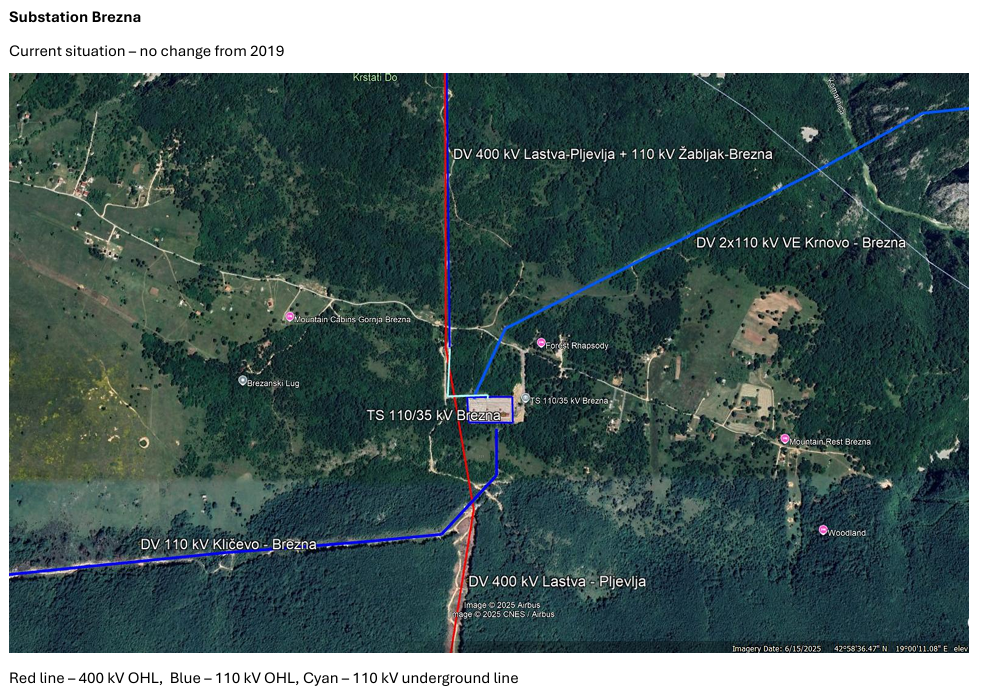
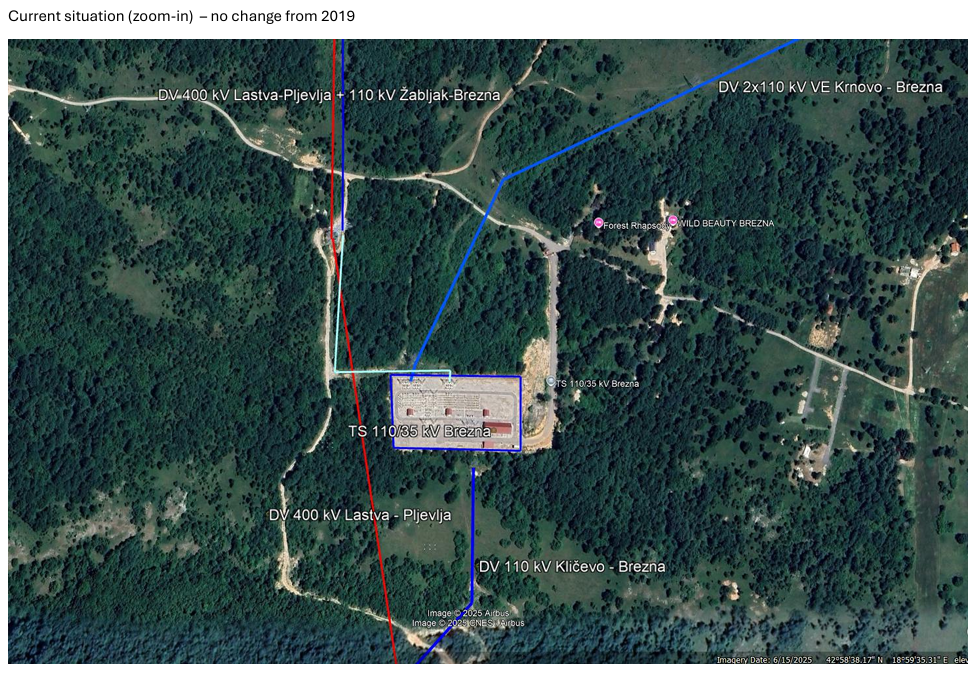
Using the existing location and already built grid infrastructure further reduces the need for additional land area. The 400 kV “Lastva-Pljevlja”, 110 kV “Brezna-Kličevo” and “Brezna-Krnovo” transmission lines have already been built, so any change in location would mean that the already built transmission lines would need to be relocated, which would have a negative environmental and social impacts.
9. Was the public involved in the planning process?
The planning and permitting process included legally prescribed procedures for public disclosure and consultation. Public consultations were organized when adopting several spatial planning documents in which the substation was envisaged.
CGES remains open to dialogue with the local community and all relevant stakeholder
10. How does CGES respond to concerns raised by the public??
CGES understands that large-scale infrastructure projects can raise questions and public concerns.
Therefore, the Company:
- Provides transparent information
- Cooperates with institutions and experts
- Applies the highest technical and environmental standards.
CGES' objective is to develop infrastructure that is safe, sustainable and in the interest of the citizens of Montenegro..
In this sense, concerns regarding the geological stability of the site, i.e. the potential subsidence of the substation, are unfounded. The existing (small) substation built by KGE has been successfully operating for nearly ten years. All issues that arose in the previous period due to soil characteristics in the area have been remedied. Based on recently completed geotechnical investigations, additional measures for permanent stabilization have been proposed by the field experts.
Regarding the new part of the facility, licensed designers have developed a geotechnical study and a preliminary construction project based on detailed geotechnical surveys. The proposed measures, including deep foundation works, are common practice in the construction of facilities in Montenegro and beyond, and are intended to ensure the long-term stability of the site, the structures, and the equipment installed there.
11. When is the project expected to be completed?
The works are being carried out in phases, and the completion of the substation upgrade is planned in line with the transmission network development dynamics and the implementation of related energy projects.
Tendering activities are currently underway, which are expected to result in the selection of the main equipment supplier (transformers), the main contractor and of the consultant responsible for supervising the execution of works
Construction is planned to begin in 2027, with completion expected by 2029.
12. Where can citizens obtain additional information?
All information about the project will be available through:
- The official CGES website and public announcements
- Direct communication with the Project Implementation Unit, appointed by the CGES Executive Director.
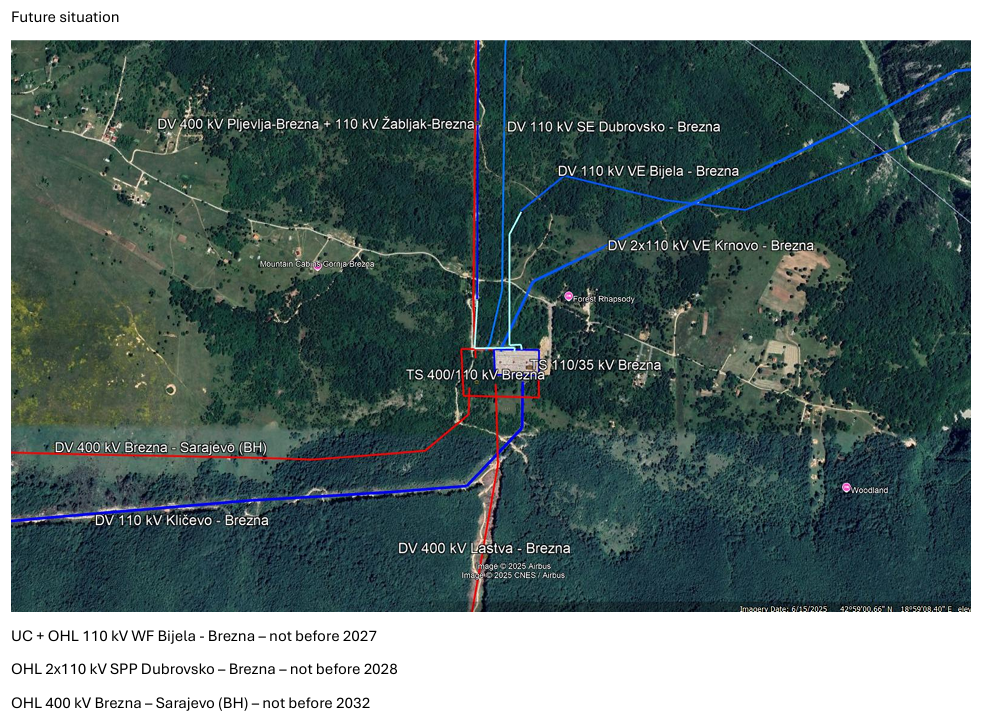
Below are maps showing the current state of the transmission grid, which has remained unchanged since 2019, as well as the planned future state, including the addition of a 400 kV transmission line towards Sarajevo and two 110 kV lines connecting two power plants.