
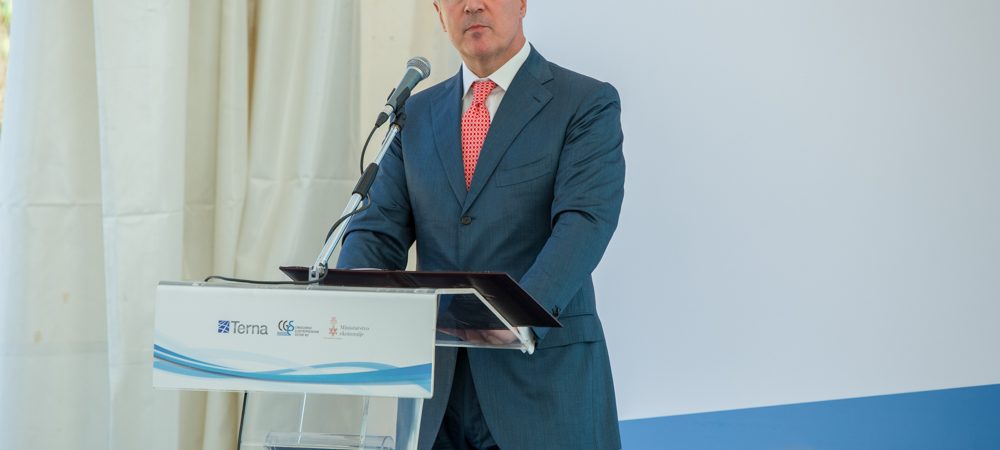
Terna, Montenegrin Electric Transmission System (CGES) The Ministry of Economy and Terna organised a ceremony at the Jazu site to mark the laying of the energy cable for the Italy-Montenegro interconnection. Speakers at the event included Matteo Del Fante, Chief Executive Officer of Terna, and Milo Đukanović, Prime Minister of Montenegro.

This is the first energy bridge to be realised with a subsea cable between the EU and the Balkans. It will cross the Adriatic Sea, connecting the Terna station in Villanova (Pescara), Italy, with the CGES station in Lastva Grbaljska, Montenegro.
The Italy-Montenegro interconnection, through the laying of a power cable, will represent a great energy bridge between the Balkans and Europe. The energy link between Italy and Montenegro is a project of strategic European importance. It represents a hub of exceptional importance for the European Energy Union, strengthening the network of electrical flows to integrate the entire Balkan region into the EU, via Italy.
Montenegro occupies a special position and has a transmission network that is well-connected to its neighbours (BiH, Serbia, Kosovo, Albania, and via them to Bulgaria and Romania), putting it in a strategic position to act as an energy exchange platform. As a result of an intergovernmental agreement between the two countries, the project has been included by the European Commission among projects of common European interest.
Both countries benefit. A shared benefit is an increased security for both energy systems, through a direct current (HVDC) connection, which contributes to the systems' adaptability, thanks to its rapid response time in the event of disruptions. The benefits for Italy include increased energy system security, particularly for central Italy, and further significance for the country's role as a hub for the Mediterranean. Meanwhile, around 35 companies and approximately 215 people are working on the construction site itself.
The benefits for Montenegro are strengthening the country's role as an energy exchange platform for the Balkans and the EU, enhancing integration with the European energy market, the implementation of the plan to strengthen the national transmission network and the coastal area with high tourist visitation, and employment for over 500 people and more than 30 local companies during the implementation phase (lasting 4 years). Over 200 people will be employed on the construction site daily during the most demanding activities.
The start of the works was officially marked by Prime Minister Milo Đukanović and the Chief Executive Officer of the Italian company Terna, Matteo del Fante.
-With the works starting today, we are entering a new phase of the strategic project 'Submarine Cable', which is being implemented by the Italian state-owned company TERNA and the Montenegrin Transmission System Operator (CGES). From the Italian coast, 136 kilometres of cable have already been laid, the total length of which between Pescara in Italy and Cape Jaz is 455 kilometres. Not far from here, CGES is building the "Lastva" substation, as well as the 400-kilovolt "Lastva–Čevo–Pljevlja" transmission line. The total value of the submarine cable is over 800 million euros. The work is scheduled for completion by the end of 2018, the Prime Minister emphasised.
In just a few years, he added, this project has gone from an initial idea, through a ratified international agreement between Montenegro and Italy, to being accepted as a strategic interest not only for our two countries, but also for the Western Balkans and the EU. Its added significance is secured by its role as a generator of the region's accelerated energy development, which is charting a new energy route – the Trans-Balkans Corridor. It intertwines the interests of the Energy Community, as well as those of the Western Balkan countries. This is also confirmed by the fact that the EU, through the Western Balkans Investment Framework, has supported this project with a €25 million grant, intended for the construction of the 400-kilovolt Pljevlja–Bajina Bašta interconnector.
Đukanović pointed out that the submarine cable is unique due to the exceptional technical challenges, which we are successfully overcoming thanks to the professional reputation of our strategic partner, the company TERNA. The works are being carried out along the bottom of the Adriatic Sea, at a depth of up to 1,200 metres, with a nominal DC transmission capacity of 1,000 MW. The Montenegrin electricity transmission system, which is majority state-owned, in partnership with one of Europe's largest electricity transmission operators, is confirming the ability of domestic companies to participate in the realisation of such demanding projects.
According to him, the benefits of the submarine cable project, which will connect Montenegro and the region to the strong and stable energy market of Italy and Europe, are already evident. This project alone, from the converter station in Lastva Grbaljska to Cape Jaz where we are located, involves the employment of over 500 people and more than 30 local companies. During the most demanding phase of this part of the project's implementation, over 200 people will be employed daily.
In addition to this section, a significant domestic workforce, as well as construction crews, will also be required for the construction of the Lastva substation. This is also the case along the entire four-hundred-kilovolt transmission line from Lastva, via Cetinje, Nikšić, Šavnik, Žabljak and Pljevlja. It is expected that following construction, the maintenance and operation of this new part of the system alone will require dozens of new, highly skilled jobs.
Following the commissioning of the submarine cable, significant revenues will also be secured for Montenegro based on CGES's share of the cable's total capacity – 20 per cent of the installed 1,000 megawatts. Revenues from transmitting electricity from the region via this interconnection are a direct benefit. No less significant for Montenegro's electricity system is the fact that it will be integrated into the regional and European market. The creation of an integrated electricity market, and the increase in competition, will enable industry and citizens to be supplied based on lower wholesale energy prices.
The implementation of this project will contribute not only to greater openness of our electricity system, but also to the economy as a whole. It is a confirmation that the optimal use of available resources is the most important condition for dynamic economic development, which will be more easily achievable through integration into the single European market in all sectors, including energy.
Decades-old ideas about utilising Montenegro's energy potential through the 'Submarine Cable' project are now gaining new momentum. A few days ago, on 29 September, we signed the Contract for the construction of the second block of the Pljevlja Power Plant. Construction work on the Krnovo Wind Farm is in its final phase. Interest in the hydro-potential of the Moraca and Komarnica rivers is growing ever stronger. Experts in this sector estimate that the 'Submarine Cable' also provided a positive impetus for the recently completed major energy facilities in Bosnia and Herzegovina (TE Stanari) and Albania (HE Banja). This striking energy bridge is a compelling illustration of the EU's effective policy of enlargement towards the Western Balkans, and at the same time, a confirmation of the region's countries' determination to base their future development on the highest European standards. With it, Montenegro also essentially becomes the energy link for the Western Balkans with the EU.
Furthermore, upon completion of this work, Montenegro will strengthen and modernise its transmission networks in the coastal region, as well as in the north-western part of the country. The first results are already visible. This will enable a much higher level of security and reliability of power supply for users, which is one of the key prerequisites for current and future major investments in tourism. On the other hand, the opening of a new energy corridor in an area with significant untapped energy potential creates the prerequisites for new major investments in the energy sector. The successful harmonisation of these two realistic development goals, by bringing us closer to the European energy market, will undoubtedly contribute to both raising the quality of life for our people and accelerating our attainment of a European level of development," concluded Milo Đukanović.
Today is an important moment for the electrical development of Italy and Montenegro, he said. Mateo del Fante. We are beginning the inauguration of the first land-based electric cable route, an innovative project that will make it a safer and more efficient 'electric corridor' between Europe and the Balkans, for the first time in the history of European energy.
We are starting here with an electricity connection that will be ready and operational in 2019, a true high-capacity energy route, which will unite two countries by strengthening and upgrading electrical plants, thereby supporting their development and growth.
This relationship and infrastructure will continue to grow in the coming years, as soon as the expected electrical works connecting to Serbia and other countries in the region are operational, and will lead to a new and innovative 'smart grid' in the Balkans, he emphasised. Mateo del Fante.