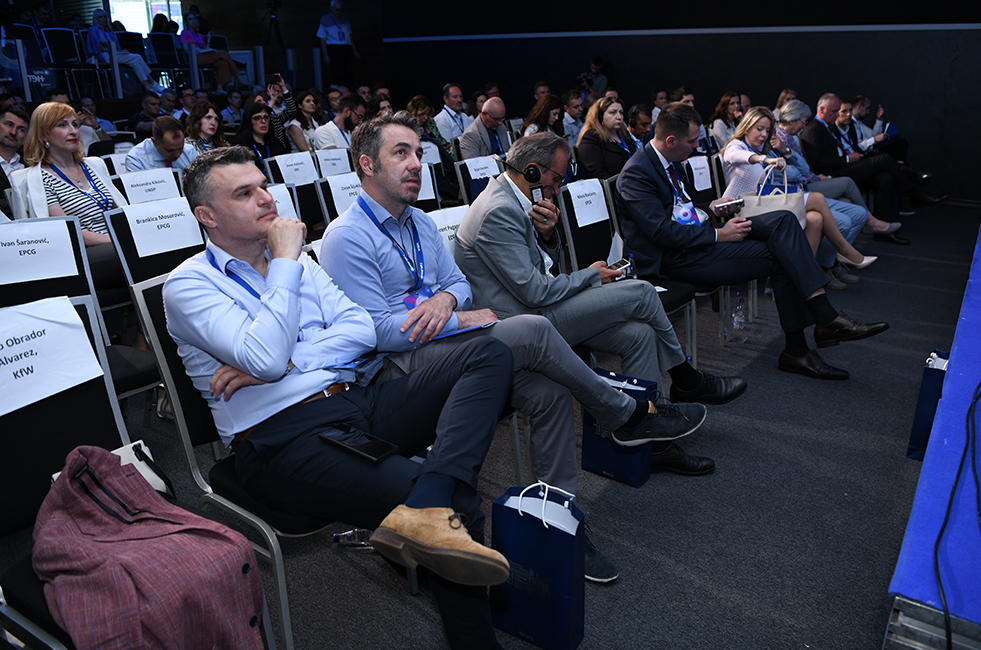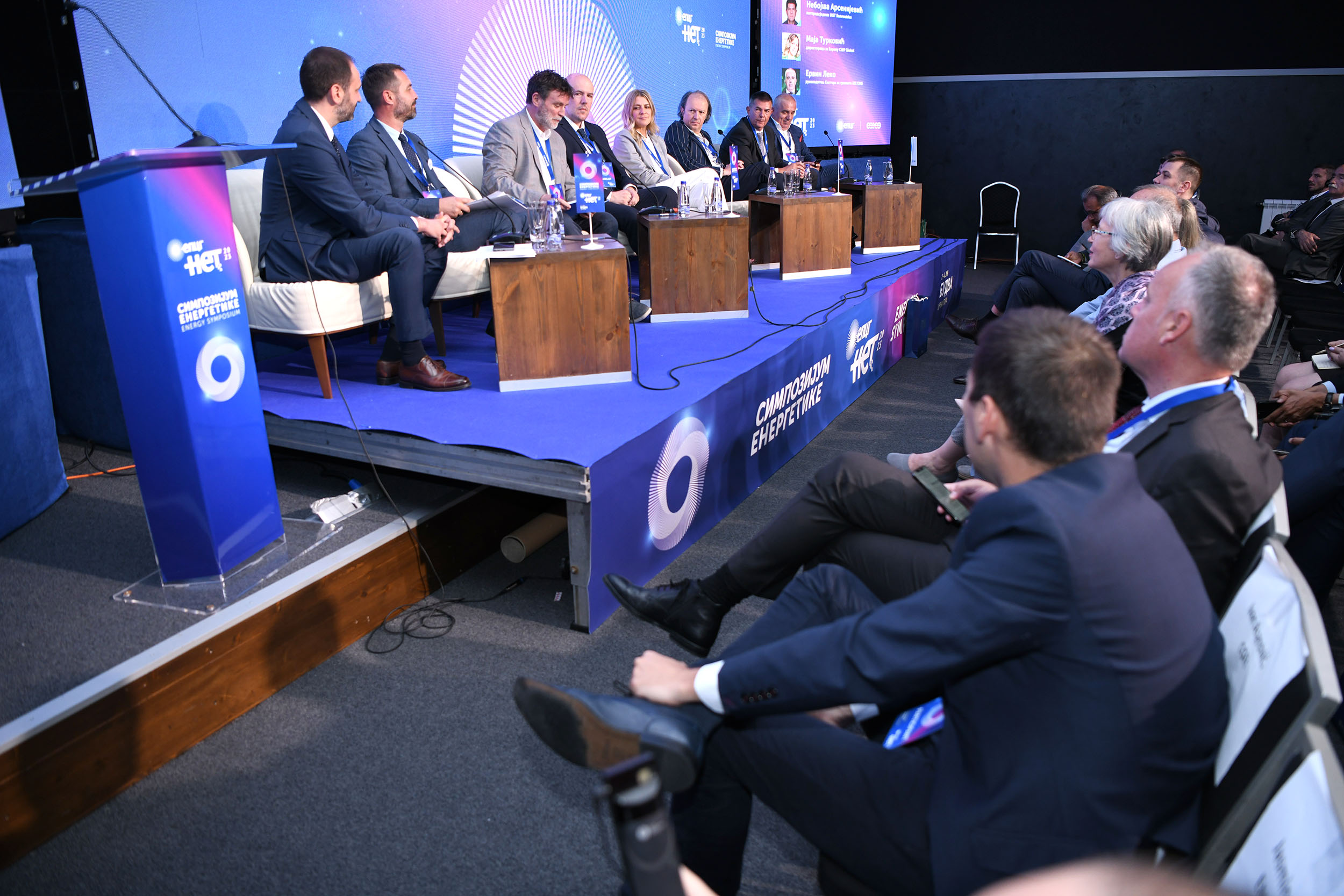
A successful green transition is not possible without close cooperation between governments, the private sector and international organisations, was the message from the second EPCG NET 2023 Symposium, held at the Hotel 'Avala' in Budva.
What are the potential solutions, best practices and strategies that will enable the Western Balkans to achieve an optimal energy mix? What are the challenges of implementing and integrating renewable energy projects? What has been done so far in the field of electricity market integration and what are the plans for the future?These were the topics of a very significant panel entitled 'The Optimal Energy Mix for the Future and the Challenges of RES Integration', on which one of the seven panellists was our Executive Director, Ivan Asanović, who, as he assessed Matija Tadić, the panel moderator, brings a wealth of knowledge, experience and expertise in the field of electricity.
Over the last few years, awareness has been growing that the transmission network is becoming one of the most important national resources.In this regard, CGES has invested significant funds in strengthening and modernising its capacities, as well as in new projects of regional importance, the most notable of which are the Trans-Balkan Power Corridor and the submarine cable connecting the energy systems of Montenegro and Italy. When asked what challenges CGES, as the transmission system operator, faces, Asanović pointed out that CGES has been recognised in the past, not only locally but also more widely, for its significant investment in the development of the transmission system.Two projects in particular stand out: the subsea interconnection with Italy, and the Trans-Balkan Corridor, which will create an energy bridge from Italy through Montenegro, BiH, and Serbia to Romania. This corridor also includes the planned completion of the 400 kV 'Lastva-Pljevlja' transmission line, which represents a remarkable achievement.
Regarding the biggest challenges facing the transmission network, which are also characteristic of all neighbouring systems, Asanović highlighted the problem of elevated voltages in the network. However, as he pointed out, CGES is taking all available operational management measures, including, more recently, the so-called. "tap staggering", and the procurement of a 250 MVA variable shunt reactor at the Lastva substation is planned.
The impact of market developments and changes in the production of RES in the region and across the entire European interconnection on system security has been significant for some time. On this occasion, Asanović pointed to the event of 8 January 2020, when the network of Southeast Europe separated from the rest of the interconnection.In the meantime, there have been several critical events that could have led to similar consequences.
The second problem is ensuring a sufficient volume of system reserve to achieve adequate operational safety and balancing, stated Director Asanović, who also spoke about the great interest from investors in building renewable energy sources, but also about the first detailed analyses which showed that it is possible to connect up to 1.5 GW of renewable sources with relatively minor interventions in the construction of the transmission infrastructure.
Ivan Asanović also announced the construction of the 400 kV 'Čevo' substation, which, he stated, will serve to connect several solar power plants at that location, and into which three 400 kV lines will be introduced on an 'in-out' basis.
Director for Europe of CWP Global, Maja Turković, She said that there is an increasing move towards strategic partnerships between state-owned and private companies.
"Strategic partnerships are good, but they will not be sustainable if they are not mutually beneficial. That will be our biggest challenge – competitiveness for projects," stated Turković.
Speaking about the stability of the energy system, Turković pointed out that it is very important, as institutional decisions are made on that basis.
She said that only the state can protect its resources.
"The only way to protect their resources is for the other party, to whom you are providing resources, to fulfil everything it has committed to, within the timeframe it has committed to, or it will otherwise face financial consequences for it," said Turković.
Vice President of UGT Renewables, Nebojša Arsenijević He pointed out that the public sector is facing problems, including a lack of capacity and an issue with regulations in a particular state.
He said that it exists The position that wind and solar projects are not financed by state-owned companies.
“"The transition process must be planned and proceed in its own course," said Arsenijević.
Professor and representative of Fractal d.o.o. Split, Ranko Goić is, gopening On renewable energy sources, he said that four or five wind farms are being built in Croatia, which are remnants of old projects started ten or 15 years ago.
"What is characteristic in Croatia, and what has happened in the last two or three years in terms of the actual realisation of projects, are solar power plants," stated Goić.
Also, as he pointed out, they have plenty of funds and financial incentives which have caused a 'rush to build power plants'.
According to him, now everyone wants to have a solar panel fitted.
This has not only happened in Croatia, but also in most EU countries, where applications for connections have increased. OWe have now reached a situation where we are asking ourselves what we are doing, because we now need more connections than the system has megawatts," said Gioć, adding that when they tried to solve this, they changed the laws, but things remained the same, because it is not a problem that can be solved in that way.
Technical Director, BELEN, Dejan Drašković He said that our electricity prices are constant.
"What we have managed to show is that everything offered at the exchange was able to find a sale," stated Drašković.
Director, SEEPEX A.D. Miloš Mladenović, He said that the existing active pricing system is the only one that can provide a suitable price signal to decision-makers and indicate that something needs to be changed.
"Customers need to be given enough flexibility to have contracts with more than one supplier at the same time," said Mladenović.
His message was that narratives about a regional market should be avoided, as they are 'out of fashion', and that we should instead speak more about connecting with the single European market.
Also speaking on the panel was rHead of the EP HZHB Market Sector, Ervin Leko.