
CONTINUATION OF TERNA AND CGES’ PROJECT
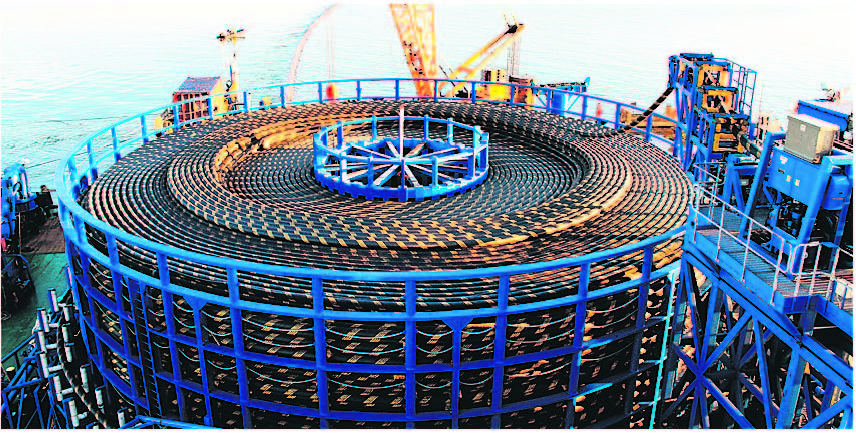
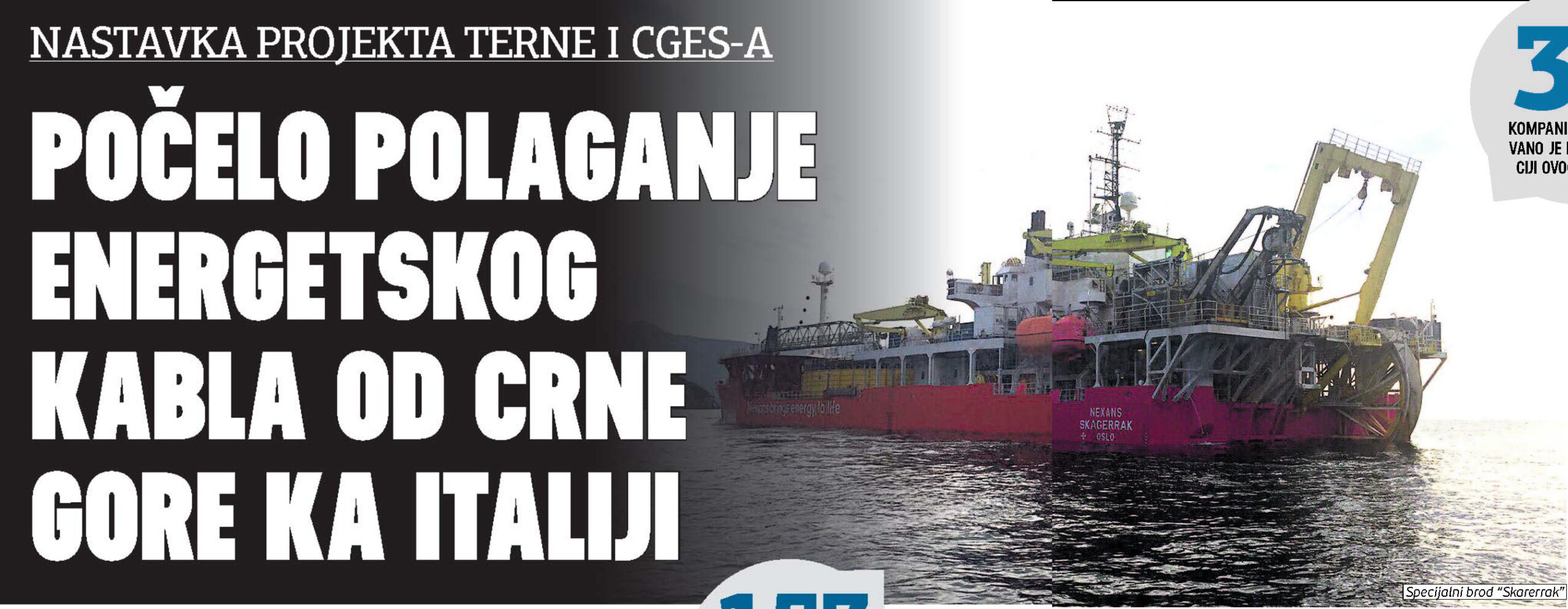
Laying of the undersea power cable from the Montenegrin side towards Italy began yesterday, as confirmed to Daily Newspapers by several sources. Laying of the cable in the length of 157 kilometres is planned in the first phase, and the works are performed by a Norwegian company Nexans.A special ship of this company “Skarerrak” has recently come into Montenegrin territorial waters, and in the next days, as learned by DN, they will be laying the cable in the Adriatic Sea in two shifts.
■ Cable laying
The cable is tied from the ship to the terrestrial part of the cable, which was ceremoniously laid in October.
This project is the first power bridge implemented by means of the undersea cable between EU and the Balkans. It will connect the Terna station in Villanova (Pescara) in Italy via the Adriatic Sea with the CGES station in Lastva Grbaljska in Montenegro.
The power connection between Italy and Montenegro is the achievement that has European strategic relevance. It is the node of paramount importance for European Energy Union, thus strengthening network of electricity flows for the integration of the entire Balkan region into EU via Italy.
Montenegro occupies a special place and it has a grid well connected with neighbours (B&H, Serbia, Kosovo, Albania, and through them also with Bulgaria and Romania), it is in a strategic position to have a role of platform of power exchange. As a result of intergovernmental agreement between the two countries, the European Commission included the project into project of European common interest.
Huge benefits
Both countries have the benefits. A common benefit is the increased safety of the two power systems through the HVDC connection which contributes to the system flexibility thanks to the speed of response in case of disturbances. Benefits for Italy are the increased safety of the power system, in particular for the central Italy, additional significance for the country’s role of the Mediterranean node, while about 35 companies and about 215 persons are working on the very construction site.
Additionally, benefits for Montenegro are the strengthening of the country’s role of the power exchange platform between the Balkans and EU, facilitating integration into European power market, implementation of the plan of strengthening national transmission network and coastal area that is visited by many tourists, and employments of more than 500 parsons and over 30 local companies during the project implementation. Over 200 persons will be employed on daily basis on the construction site during the performance of the most demanding activities.
A billion euro project value
In mid-November 2010 a contract was signed on the implementation of the project of connection between Italy and Montenegro by means of power cable. The contract was signed by the then Montenegrin Minister of Economy Branko Vujović, Chairman of CGES Board of Directors Zoran Đukanović and Executive Director of Terna Flavio Kataneo. The value of the project is about a billion euro, and Montenegro participates in the implementation with one hundred million euro.
Italians have continued the laying
Italian company Terna has continued laying of the power cable towards Montenegro, as recently communicated by the Italian media. Works have started on the coastal area of Peskara, and will be completed by 31 December.
On the bottom of the Adriatic Sea, from the Italian side, about 250 kilometres of the cable is yet to be laid.
A company "Poliervizi SRL”, which will lay new kilometres of the power cable from the special ship "Ievoli” to the bottom of the Adriatic Sea, has been hired to continue project implementation.
For the purposes of project continuation, the Port of Peskara has ordered all floating units to undertake to cautiously enter parts of the Adriatic Sea where the power cable is to be laid. Besides, the Port has announced that all vessels must be 500 meters away from the ship "Ievoli” from which the cable will be laying every day into the Adriatic Sea by the end of 2016
Source: Dnevne novine