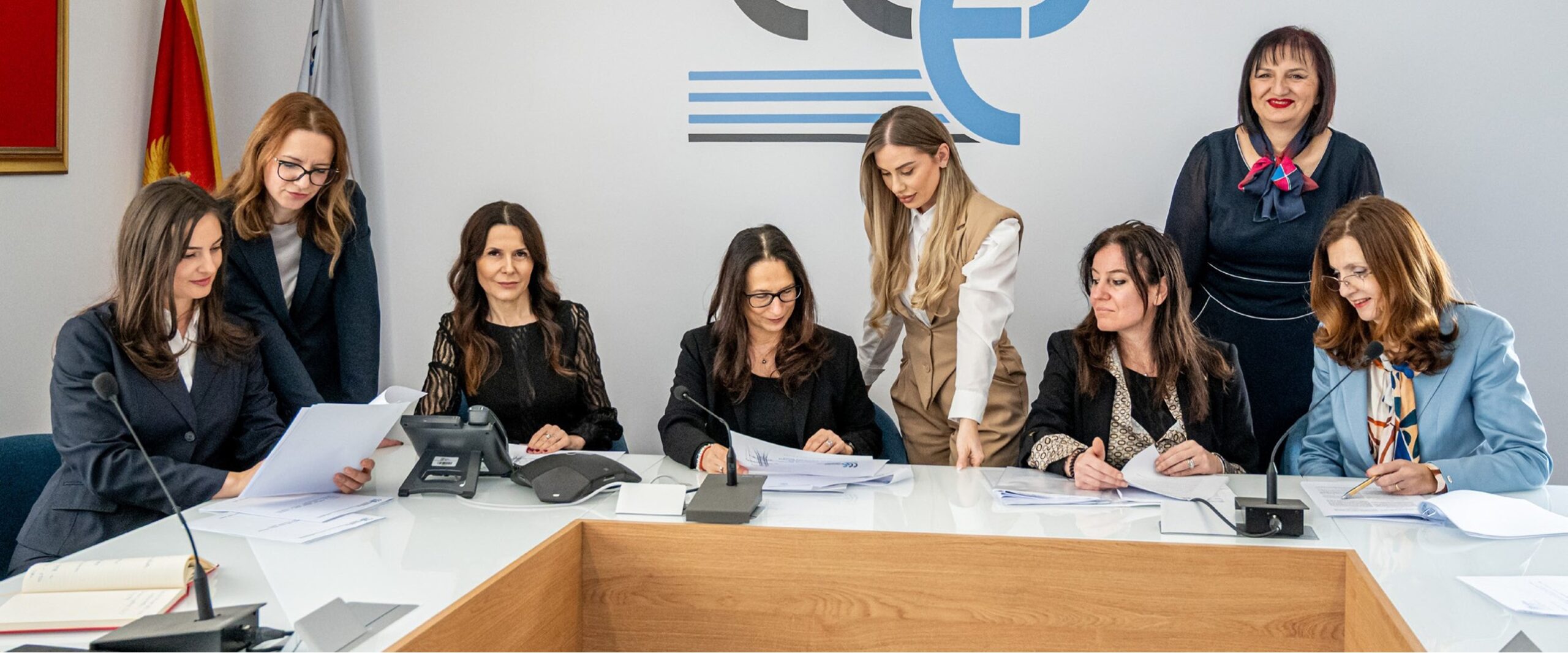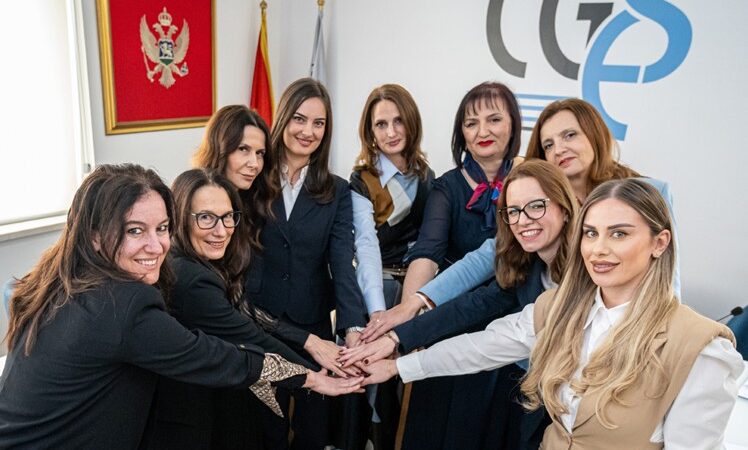
Corporate social responsibility is also reflected in its approach to employees and their professional development. In line with ESG principles, knowledge, competencies, and performance should form the basis for career advancement, regardless of gender and fostering an environment that supports this principle is an essential part of responsible corporate governance. At CGES, this is neither a new development nor a response to current trends, but rather an integral part of the corporate culture that has evolved over the years and continues to be demonstrated in practice.
EIGHT FEMALE LEADERS COVERING KEY ROLES IN CGES
There are values that are not introduced by decision — they are built over time. In Crnogorski elektroprenosni sistem, gender equality was never a reaction to a trend, nor a response to public expectations. It arose naturally, through the way the company adopted decisions, chose personnel and built trust.
In periods when women in management structures were a rarity in the business environment, CGES recognised competence as the only measure of professional advancement. Without the need to emphasise or prove, women assumed responsible roles, led processes and participated in shaping the company's strategic directions. It was not the exception — it was the standard.
Today, when the number of female leaders who successfully manage complex systems and achieve measurable results is growing in Montenegro, our company confirms what has long been part of its identity.
Women in the management structures of our company are not a symbol of equality — they are its content. Their decisions are behind system stability, project implementation and overall business results.
In CGES, contribution is not measured by percentages, but by responsibility. Management implies duration, consistency and willingness to take the burden of the decision. It is precisely in these processes that the company's female leaders give their full professional capacity. Their work is not a separate segment, but an integral part of a structure that functions as a whole.
For CGES, leadership was never a matter of form, but of responsibility. Our company did not build equality through campaigns, but through the continuity of decisions that confirmed over the years that knowledge, professional consistency and results are the only criteria for advancement. This is precisely why the presence of women in management structures in our company is not an exception that should be highlighted — it is a natural reflection of a system that has always recognised quality.
CGES did not follow trends, it set standards. And while in the public space gender equality is often presented as a novelty or a challenge, in our company, it has long been a part of daily management practice. This is a difference that is not only reflected in the structure, but also in the stability, results and culture of responsibility that we are building.
We shall briefly introduce our leaders.
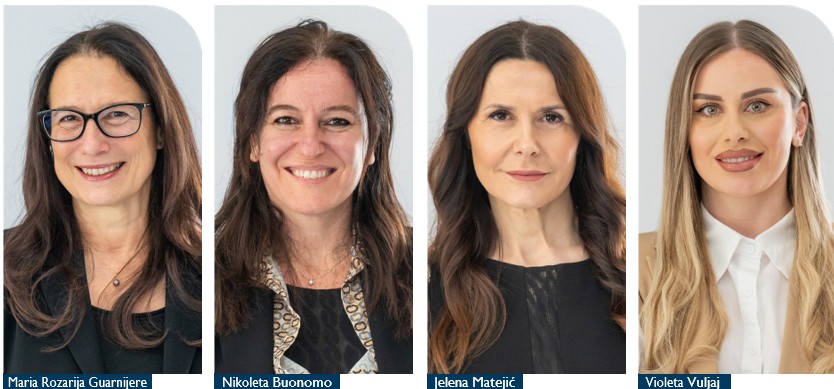
Maria Rozarija Guarnijere - a member of CGES Supervisory Board, performing duties of the Chair of CGES Supervisory Board, Executive Vice President for Engineering and Project Execution at Terna Rete Italia S.p.A. and one of the key leaders of European electric power infrastructure projects. Since the founding of the company, she has led the implementation of the most demanding submarine and HVDC connections, and then the development of capital AC projects of national importance. As a member of the board of directors of several power companies, she actively shapes the strategic direction of transmission system development across the region.
Nikoleta Buonomo – a member of CGES Supervisory Board, Executive Vice President for Internal Audit at the Terna Group, where she leads the systems of corporate supervision and risk management at the group level. Through her many years of membership in the management and supervisory boards of companies within the system, she strongly contributes to transparency, stability and sustainable business growth. She built professional integrity and expertise from international audit firms to the highest management structures of the power sector. Through responsible advisory and inspection positions, she developed projects in the field of entrepreneurship, fiscal policy and local public revenues.
Jelena Matejić – a member of CGES Supervisory Board, holding the position of General Manager of Elektromreža Srbije since 2017. She leads the investment and development cycle of strategic importance for the energy stability of Serbia and the region. Her many years of experience in investment management, strategy and public systems position her as a strong leader in the transformation of electric power infrastructure.
Violeta Vuljaj – a member of CGES Supervisory Board. She started her professional career in the private sector, and since 2019, she has been directing her expertise towards public administration, taking on increasingly responsible roles in the field of economic and development policies. Through work on development projects, entrepreneurship and local public revenues, she built a strong understanding of fiscal policy and institutional management. Today, focused on the field of public procurement, she actively contributes to the improvement of transparency, strategic planning and efficiency of public spending.
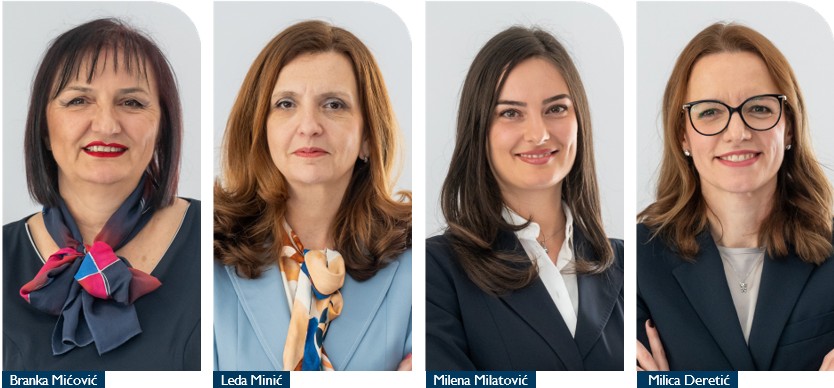
Branka Mićović – a member of CGES Management Board, a leader in the field of information technology and cyber security at CGES, with many years of experience in the modernisation of critical infrastructure. She led the transformation of the IT system and the development of data protection strategies, raising the company's security standards to the European level. By actively participating in international expert bodies and implementing advanced security solutions, she contributes to strengthening the resilience of the power system in the digital environment.
Leda Minić – Director of Elektroprenos, is an experienced engineer and leader of large infrastructure projects at CGES, with more than 25 years of experience in the transmission system. She gained hands-on experience in the field, working in both transmission line maintenance and the construction of power infrastructure. She led the implementation of several major infrastructure projects at CGES, including the construction of the 400 kV Podgorica–Tirana transmission line and the Čevo–Pljevlja section of the 400 kV Lastva–Pljevlja transmission line, as part of the Montenegro and Italy submarine cable inerconnecion project.Her management experience in projects financed according to the rules of international institutions confirms a high level of expertise and operational excellence.
Milena Milatović – Director of the Financial and Economic Sector at CGES and the holder of the company's financial stability and strategic planning. Since the beginning of her career at CGES, she has built strong expertise in budgeting, financial analyses and capital investment management. Through the modernisation of financial processes and the implementation of modern ERP solutions, she significantly improved the transparency and corporate governance efficiency.
With many years of experience in CGES, Milica Deretić, Director of the Regulatory, Legal and International Cooperation Sector, performed a number of key operational and strategic functions, including Director of the National Dispatch Centre. Today, she manages regulatory and international processes, strongly contributing to the alignment of the power sector with European standards and strengthening the company's international position.
Below we speak through their messages — based on results, shaped by responsibility, and focused on the future.
How does your international professional experience contribute to the work of the Supervisory Board and strategic decision-making in CGES?
JELENA MATEJIĆ, SUPERVISORY BOARD MEMBER:
“Being a member of CGES’s Supervisory Board represents a professional responsibility for me, but also a privilege to participate in decision-making that is important for the stability of the energy sector across the region. As the CEO of Elektromreža Srbije, I also see this role as an opportunity to contribute to further strengthening security of supply and the long-term development of our transmission systems.
Working for transmission system operators naturally entails intensive international cooperation and provides a broader perspective on the challenges facing the power sector today. The implementation of major cross-border infrastructure projects, the energy transition, the integration of renewable energy sources, and the development of electricity markets all require continuous coordination and the exchange of experience among companies. Such cooperation is precisely what enables strategic decisions to be made with due consideration of the broader regional and international context.”
What does it mean to you personally to be part of the governing body of a company as complex and strategically important in Montenegro as CGES?
VIOLETA VULJAJ, SUPERVISORY BOARD MEMBER:
“It is, first and foremost, a significant responsibility. CGES is a system of strategic importance to the country, and every decision must be guided by a long-term perspective, careful consideration, and the need to ensure the power system stability.”
What inspires you even today to build the stability and development of the system you manage with the same dedication?
BRANKA MIĆOVIĆ, MANAGEMENT BOARD MEMBER
“What continues to inspire me most is the people I work with, the responsibility we carry, and the opportunity to contribute to the development of a system to which I have devoted most of my career. As Director of ICT Sector, my focus was on operational management and the implementation of development projects, whereas my current role as a member of the Management Board allows me to draw on that experience in strategic decision-making and the company’s long-term development.
Regardless of my position, I remain committed to the same values: professionalism, accountability, and continuous improvement. I believe that a stable and successful system is built through teamwork, a clear vision, and a willingness to meet the challenges of the future.”
“My advice to younger colleagues is not to simply seek out tasks, but to embrace challenges: to see every process as an opportunity for improvement and to recognize that their work has a tangible impact on the safety and reliability of the system. When you see the bigger picture and take responsibility for your work, professional growth becomes a natural progression, while the knowledge that your contribution makes a real difference becomes the strongest source of motivation.”
How do you see the role of women in shaping the future of a sector that was predominantly male for decades?
LEDA MINIĆ:
“I have never thought of the energy sector as a man’s profession. Had I done so, I would have chosen a different career. Over time, my experience has confirmed what I intuitively felt when I chose this profession: the energy sector knows no gender; it requires dedication, precision, logic, knowledge, and innovation. Men and women contribute best to these qualities by working together. In general, women tend to bring a somewhat more empathetic approach, which was initially perceived as a weakness. Experience has shown, however, that this approach is often more effective and productive, particularly in the long term.”
"Choose the profession you want, regardless of stereotypes. As long as you pursue your aspirations, it does not matter whether your career path leads you into energy, the arts, sports, agriculture, economics, science, or any other field. Whatever path you choose, what matters is that you build your career on knowledge, dedication, and collaboration.
Remember, the energy sector is not a closed circle, but a field of boundless opportunities for everyone willing to pursue them. And in business, women’s solidarity is a powerful force for progress.“ren krug, već polje beskrajnih mogućnosti za sve koji to žele, a ženska solidarnost u biznisu najmoćnije gorivo za napredak.“
What moment in your career made you realize you were ready to take on a leadership role?
MILENA MILATOVIĆ:
“It was neither a single moment nor something that comes with a title. I believe leadership is built every day through consistency, integrity, the way we make decisions, and how we treat people, especially in difficult times. That is why I believe true leaders never stop learning: from results, from mistakes, and from the people they work with. It is only through this continuous learning that we can lead effectively over the long term and make things better.”
“Integrity is your greatest asset. In times of rapid change, those who go furthest are the ones who have the courage to stay true to their values, even in the most challenging circumstances.”
How do you define leadership today - as a position, a process or a personal calling?
MILICA DERETIĆ:
“Leadership is neither a position nor a calling, but a way of inspiring those around us to work towards shared goals. It is not simply about giving orders or exercising control, but about the ability to awaken in others the desire to invest themselves in something meaningful and find fulfilment in doing so. Above all, I believe in leading by example. This approach inspires and motivates others, builds trust, sets clear standards, and strengthens a culture of collaboration. When leadership is focused on fostering a healthy and supportive work environment, and this approach becomes the standard, it creates a culture of accountability, mutual respect, and trust—one that benefits both the company and its employees.”
“Finding fulfilment in our work inspires excellence, while passion for what we do lays the foundation for outstanding results. Choose your path wisely, never stop learning, invest in your own development, and be someone others can rely on. Responsibility and recognition will follow naturally.“